- 7 mins read time
- Published: 10th June 2026
Response to the National Policy Statement & Roadmap on Circular Textiles 2026–2028
There is a lot in this National Policy Statement that is welcome and long overdue. It shows a clearer understanding of the scale of the challenge in the textiles system and a stronger attempt to move from aspiration to structured action. Importantly, it recognises something that those working on the ground already see every day. The current model of textile production and consumption is broken, and the burden of managing its consequences has largely fallen on charities, collectors and local authorities.
That acknowledgment is important. But the real test of this policy will not be in how well it describes the problem. It will be in whether the actions are strong enough to change it.
The most significant development is the introduction of Extended Producer Responsibility (EPR) for textiles. This is a critical shift. For too long, responsibility for managing post-consumer textiles has sat downstream, with those that have no control over what is placed on the market. EPR begins to correct that imbalance by placing financial responsibility back on producers.
If designed well, an EPR has the potential to transform the system. It can provide long term funding for collection and sorting infrastructure, incentivise better product design, and help stabilise a system that is currently under severe pressure. It also reflects a basic principle that those who place products on the market should contribute to managing their full lifecycle.
However, this is also where the success or failure of the entire roadmap will be decided. EPR can either become a meaningful driver of change or a mechanism that primarily funds the management of waste after it is created. If it is too narrowly focused on recycling or volume based metrics, there is a real risk that it will not shift the system in the way intended.
Prevention and reuse must be central to how EPR is designed. Reuse is already the highest value outcome in the system, both environmentally and socially. Ireland has a strong and established reuse network through charity shops and social enterprises that are already delivering significant impact. That infrastructure is not theoretical. It is functioning, trusted, and widely used by the public.
While the policy recognises the importance of reuse, it does not yet fully secure its position within the future system. That is a gap that needs to be addressed. If EPR funding is not explicitly structured to support reuse outcomes and those who are already delivering them, there is a risk that new systems will develop in parallel rather than building on what already exists.
The policy also clearly identifies the issue of declining textile quality and the impact of fast fashion. This is a critical point. The system is not only dealing with increasing volumes of textiles, but also with materials that are often lower in durability and harder to reuse. That combination creates pressure at every stage, from collection through to resale and recycling.
While eco-design measures at EU level will improve product standards over time, they will not address the full scale of low-quality products already entering the market, nor the commercial incentives that continue to drive overproduction. There is still a gap between recognising the issue and putting in place measures that reduce the flow of low-quality textiles at source. Without stronger action upstream, downstream systems will continue to carry the pressure.
Infrastructure is another critical area. The policy correctly highlights gaps in sorting capacity, recycling infrastructure, and domestic processing. It also acknowledges Ireland’s reliance on export markets for a significant proportion of used textiles. This is one of the most important structural issues in the system.
At present, a large share of textiles collected in Ireland is exported, often into volatile and opaque global markets. While some of this material continues to be reused, there is limited visibility over final outcomes. That lack of transparency creates risk, particularly in a system that is increasingly dependent on international demand and external conditions. Add to this, a decline in quality, means that the reuse value of those exports is non-existent.
The ambition to build greater domestic capacity is the right one, but the roadmap is not yet clear on how this will be achieved in practice. There is limited detail on investment models, infrastructure development, or how quickly capacity can be scaled. Without that clarity, there is a risk that the system continues to rely heavily on export routes by default.
Behaviour change is another important element of the policy. It correctly identifies that awareness alone is not enough to shift consumption patterns, and that pricing, convenience and social norms play a major role in how people engage with clothing.
There is also clear evidence that incentives matter. People are more likely to repair, reuse or buy second hand when there are economic or practical benefits in doing so. However, the policy response remains largely focused on awareness and education. While important, these measures on their own are unlikely to drive change at the scale required.
There is a missed opportunity to introduce stronger structural supports, such as incentives for repair, reskilling people to repair, measures to support second hand markets, or financial mechanisms that make sustainable choices more accessible. If the goal is to normalise circular behaviour, it needs to be easier and more attractive than the alternative.
One of the strengths of this policy is that it recognises the value of the existing reuse and social enterprise sector. Ireland already has a functioning and trusted network of charity shops, reuse organisations and community initiatives that deliver both environmental and social value.
However, these organisations are operating under increasing pressure. Volumes are rising, quality is declining, and the cost of managing unsellable material is increasing. While the policy acknowledges this, it does not yet fully address the level of investment and structural support required to sustain and strengthen this network.
If circularity is to be delivered in practice, these organisations need to be treated as core infrastructure within the system, not peripheral actors.
Finally, there is the issue of data. The policy rightly identifies significant gaps in understanding material flows, particularly in relation to exports and end destinations. The commitment to developing baseline data is an important step, but it also highlights how much of the system is still operating without full visibility.
Better data will be essential for designing effective policy, particularly around EPR, infrastructure investment and measuring progress over time. Without it, there is a risk that decisions are made in a relatively incomplete evidence environment.
Overall, this roadmap represents real progress. It shows a clearer understanding of the system, a stronger regulatory direction, and an important shift towards producer responsibility. The introduction of EPR is the most significant lever and has the potential to fundamentally reshape how textiles are managed in Ireland.
However, the effectiveness of this policy will ultimately depend on a small number of key decisions. Whether prevention and reuse are properly prioritised within EPR. Whether existing social and reuse infrastructure is fully integrated into the system. And whether stronger measures are taken to address the volume and quality of textiles entering the market in the first place.
The direction is right. The challenge now is to ensure the system is designed not just to manage textiles better, but to reduce the pressure being placed on it in the first place. Ireland needs to be brave in its next step, creating a circular system for textiles that makes a strong statement to the rest of the Europe, supporting a reuse network that most countries don’t have and making sure EPR, puts responsibility where it belongs - on the producers.
Related Blog Articles
-
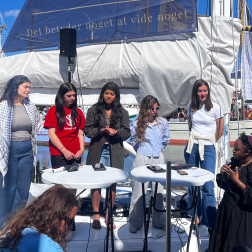
Stronger together: We travelled to a Danish democracy festival to strengthen our activism
-
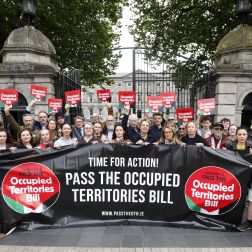
How do we rescue the Occupied Territories Bill from being watered down?
-
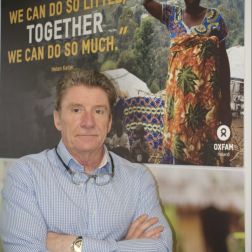
From Volunteer to Trading Director: Trevor's Oxfam Journey
The last 40 years have seen so much change, but in Oxfam Ireland one thing has remained constant throughout that whole time. Read the Journey of Trevor Anderson, Director of Trading at Oxfam Ireland. -
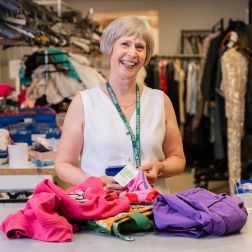
Volunteer Week: Barbara’s volunteering journey
Oxfam volunteers are making a huge impact every day and each has their own story when it comes to how they started volunteering. Here is Barbara Harper’s volunteering journey. She has volunteered in the Oxfam Holywood Superstore since it opened just over a year ago.